It's been 6 months since I updated this blog.
That's partly because of not having much time to make art in the last 6 months, but also having trouble posting because of arguments with my new computer, running Windows 8, about my having 2 google accounts. It doesn't like my split personality, so I am abandoning this blog and moving here.
I hope you'll come with me.

Sunday 29 June 2014

Friday 10 January 2014
MIxed media with maps ATCs
The theme for December's monthly ATC swap was 'Mixed media using maps'.
I had a plan. It depended on a stamp. I couldn't find the stamp.
This is 'plan B', using maps in a much m ore subtle way, which I rather like!

I started with a background made by gluing newsprint to cardstock, then using an old credit card to apply paint in reds, blues and purples. Using the credit card to spread the paint means it goes on very quickly, in a very thin layer, and dries fast. My background was too bright for me to use, so I added a layer of white gesso, again using the credit card. This gave a much more subtle effect.

The background looked a bit old and dusty, so I thought I'd go with the flow and add some cracked areas. I used a mask to keep the cracks off the area I planned to add my main image to. I used distress ink, which looked lovely, but which didn't dry properly on the gesso, despite using the heat gun, so I sprinkled with clear embossing powder and heated to 'fix' it.

Next came the main image, which I stamped with versamark, and embossed with 'blue raspberry' two tone embossing powder, for dramatic effect.

She didn't have quite enough dramatic effect, so I decided to make her stand out from the background a little more. I drew around her with an inktense pencil in what looked like a dull dark blue. I added water,a and it turned out to be a much brighter blue than I expected! I should have tested on a scrap of paper before I used it on the ATC! Still, it makes her 'pop'.

You may have noticed that there's not much evidence of maps so far. I had decided to use the map for embellishments. I took a vintage map, dampened it with water, and coloured it with faded jeans and picked raspberry distress inks.

I cut small strips of map to use as 'ribbons' across the bottom f the ATCs, then added a few french knots with hand dyed thread. Next, I used a paper punch to cut out lots of flowers. I assembled these, and used a small white brad to hold them together and attach to the ATC.

Friday 3 January 2014
Glittery book
I made this book for a swap with the theme of 'glitter'. I wanted to use glitter in a subtle way, rather than in an 'in-your-face' way.
I created the book by tearing 5 sheets of watercolour paper for the inside, and a slightly larger sheet for the cover. I painted the cover with a mixture of matte medium, turquoise, jenkins green and titan buff fluid acrylic paints and dabbed a crumpled piece of paper on it to add texture.
Once the paint was dry, I used a Basic Grey laser cut 'doily' as a stencil, and dabbed on Stewart Gill Metamica paints in 'brass' and 'verdigris'. Once dry, I added glitter by dabbing on 3 colours of Stickles, and spreading it around with my finger. It doesn't show that well on this photo, but you can see more of it on the second photo.

To finish the book off, I did a very simple binding using some tubular variegated embroidery thread, and a polymer clay. The pear was made by rolling Premo Accents clay until thin, creating texture using a rubber stamp, and baking until cured. This is the first time I've used Premo Accents and I was very disappointed because the gold isn't shiny, it's very matte. And I needed shiny. Very shiny. So, after a generous application of Treasure Gold, my pear is beautifully shiny!

Tuesday 31 December 2013
Lutradur wall hanging
I had to make something for a swap, using Lutradur.
I started by taking white lutradur, and adding a very thin layer of gesso through a stencil I then used crimson and orange fluid acrylics to colour the lutradur, the gesso takes the paint differently to the lutradur and creates a nice effect. I painted another piece of lutradur crimson, and mounted the gessoed piece onto it using gold brads.

For the focal piece, I took some dark grey lutradur, added gesso, then painted it deep brown using fluid acrylics. I glued on a moulded polymer clay embellishment, and used more gold brads to attach to the layers below. The whole piece needed some sturdy support, and some contrasting colour to make it 'pop', so I cut a piece of mount board and covered it with some bright green polyester 'fabric' from the florists. I adhered the lutradur piece to this base with matter medium, and added a little ribbon hanging loop.
Monday 30 December 2013
Maple leaves book page
More maple leaves. This is my page in a collaborative hanging book, where each player was given a colour of the rainbow. We had an extra player, so we needed an extra colour, I added crimson to the rainbow :-)
As I'd drawn a maple leaf shape to use to draw around for my textured acrylic panel, I thought I'd use it again. I layered up some autumnal colours of organza with snippets of organza between the layers, then used my special Margaret Beal soldering iron to trace around the maple leaves. As I had spare layered organza left, I created more shapes to finish the bottom of the page off.
I painted a piece of canvas with quinacridone crimson fluid acrylic paint, then I sewed the maple leaves on using variegated threads. I finished the piece by adding dots of iridescent gold fluid acrylic, using the end of a a bamboo skewer.

I have everybody else's pages now, they were all gorgeous - I really must get around to binding them into the hanging book, and put them all on display.
Sunday 29 December 2013
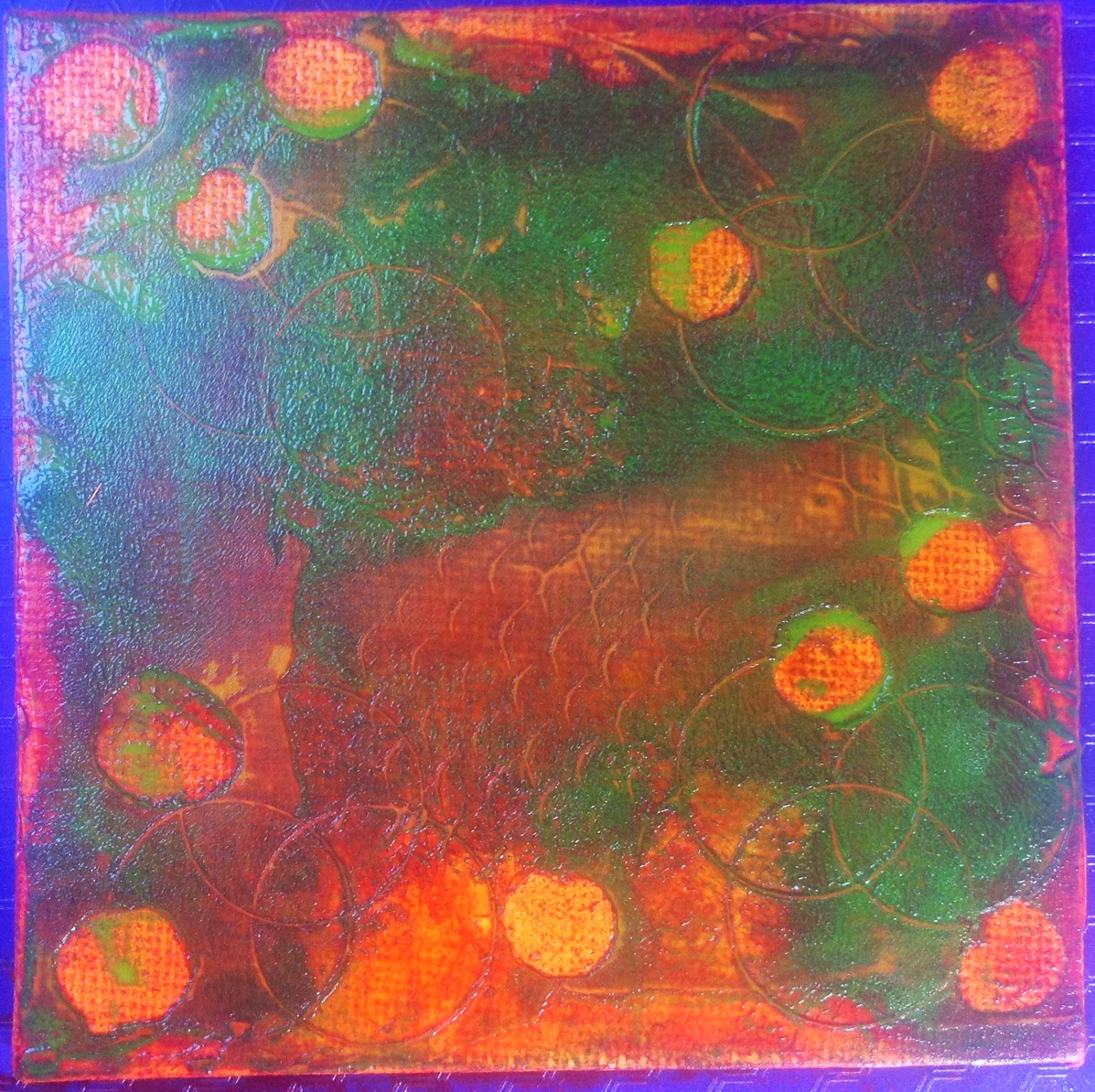
Textured acrylic canvas panel
This was an experiment, following the instructions given by Lisa Kesler, in an article called ' Texture and layers with acrylic paint and stencils', published in Cloth Paper Scissors.
The first step was to cover your substrate (I used a canvas panel) with masking tape.

Next step was to come up with a design which was a combination of a main focal image, and background shapes or images. I drew my background shapes onto the masking tape. As I'd be cutting around the shapes, I didn't choose anything complicated!

Next, I cut around my shapes using a sharp craft knife, then peeled off the masking tape from around them.

I added a layer of moulding paste, and textured it using bottle tops and pieces of netting.

Once dry, I peeled off my masking tape shapes, and painted the whole piece with watered down fluid acrylics in two or three colours, letting the colours pool in places.

Once dry, I added a warm ochre colour all over to bring it together.

Then I added green, using a baby wipe, so it didn't go into my shapes. It's not looking brilliant at this point, but I know my next layers will really help.

More layers, getting darker and warmer.

The final layer, quite a bright orange, I s added all over, including in my shapes. I'm quite liking it now. The colours in this photo are a bit brighter than real life.
For the next stage, we're back to the masking tape. Once you've covered your canvas with masking tape again, you draw your main image on the tape.

Using a craft knife, cut around your image again, but this time lift the image rather than the tape around it.

Add more moulding paste, and remove masking tape.

Once the moulding paste is dry, add more paint layers.

Paint your main image carefully, making sure you don't get any on your background.

I added several layers of crimson, then used an iridescent gold oil pastel to draw the veins on the leaf, before adding a final layer of paint. The finished piece.... which took all day on and off, 10 minutes here and there with lots of drying time in between layers.

Eagle eyed readers will have spotted that my background circles aren't all in the same place. I made several of these at the same time, and didn't always photograph the same one!
Lutradur book
I made a little book out of Lutradur, gesso, woven brass 'fabric', and beads.
.JPG)
I used 2 pieces of Lutradur about 6 inches by 4 for the cover. I coloured them with fluid acrylic paints. Once dry, I used foam stamps and gesso to add images. If you look carefully, you can see gold shiny areas, I gently stroked on some treasure gold for texture and to break up the larger areas of colour a little.
I cut strips of woven brass 'fabric', punched small holes in them, and sewed them onto the front cover with french knots. I decided that I didn't want a closure to spoil the front cover so added a button to the back cover, and made a beaded loop to close over the button. I also added beads to the pamphlet binding.
.JPG)

.JPG)
The inside of the book is also made of Lutradur, coloured and decorated in the same way but using slightly brighter colours. I folded it to a pattern, the pockets are just the right size to tuck ATCs into.
.JPG)
Saturday 17 August 2013
Been remiss
I have been remiss, I haven't blogged in months. I have been knitting, embroidering, making mixed media pieces and papercrafting, but haven't gotten around to downloading my pictures off my iPad or camera :-(

Here are the 3 jewel sisters, who live on painted canvas backgrounds. I hope you like them!
Subscribe to:
Posts (Atom)
Guestbook

